

An LED mirror can replace a separate vanity light if it provides comfortable, useful light on your face at your normal standing position. It does not automatically replace ceiling or shower lighting. Check the mirror’s lighting direction, measured output and controls before removing a fixture or changing the wiring.
By Inyouths · Sources checked October 23, 2026
Quick decision: replace the vanity light, keep it, or combine both?
Start with what each light needs to do. A vanity light helps you see your face; room lighting serves areas beyond the mirror. Removing the first does not mean the second is unnecessary.
| Your situation | Sensible starting point | What to confirm before buying |
|---|---|---|
| You want a cleaner wall without a light bar | Consider a mirror with forward-facing task lighting | Useful light at your standing distance, glare and shadow control |
| You prefer a halo behind the mirror | Keep or plan another source of face lighting unless performance is demonstrated | Whether the mirror sends enough light toward you, not just onto the wall |
| You already like your sconces | Keep them and assess the mirror as an additional layer | Combined comfort, reflections and control compatibility |
| Your mirror would be the only light in the room | Review the complete lighting layout before removing fixtures | Lighting at the shower, toilet and walking route as well as the basin |
| You share a wide or double vanity | Check both users’ positions separately | One person’s result does not establish coverage at the other basin |
These are planning choices, not a code-compliance assessment or a guarantee that a particular mirror is sufficient.

Original Inyouths decision aid: assess your face and the rest of the room separately. The diagram is not a photometric test.
Front lighting and backlighting do different jobs
For grooming, ask where the light goes. A visible glow around a mirror does not establish how well it lights your face.
A front-facing illuminated band sends light toward the user. Backlighting primarily lights the wall behind the mirror. Some products combine both. Their actual performance still depends on the optical design, output, placement and surrounding surfaces—not simply the label “LED mirror.”

AI-generated lighting illustration, not a product test. The panels show directional-lighting concepts, not measured brightness or a guarantee of how a particular mirror will perform.
Well-positioned sconces can remain useful. An integrated mirror is not automatically better than a separate light bar or pair of wall lights, and neither arrangement guarantees a shadow-free face.
For a more detailed design comparison, see our backlit versus frontlit mirror guide.
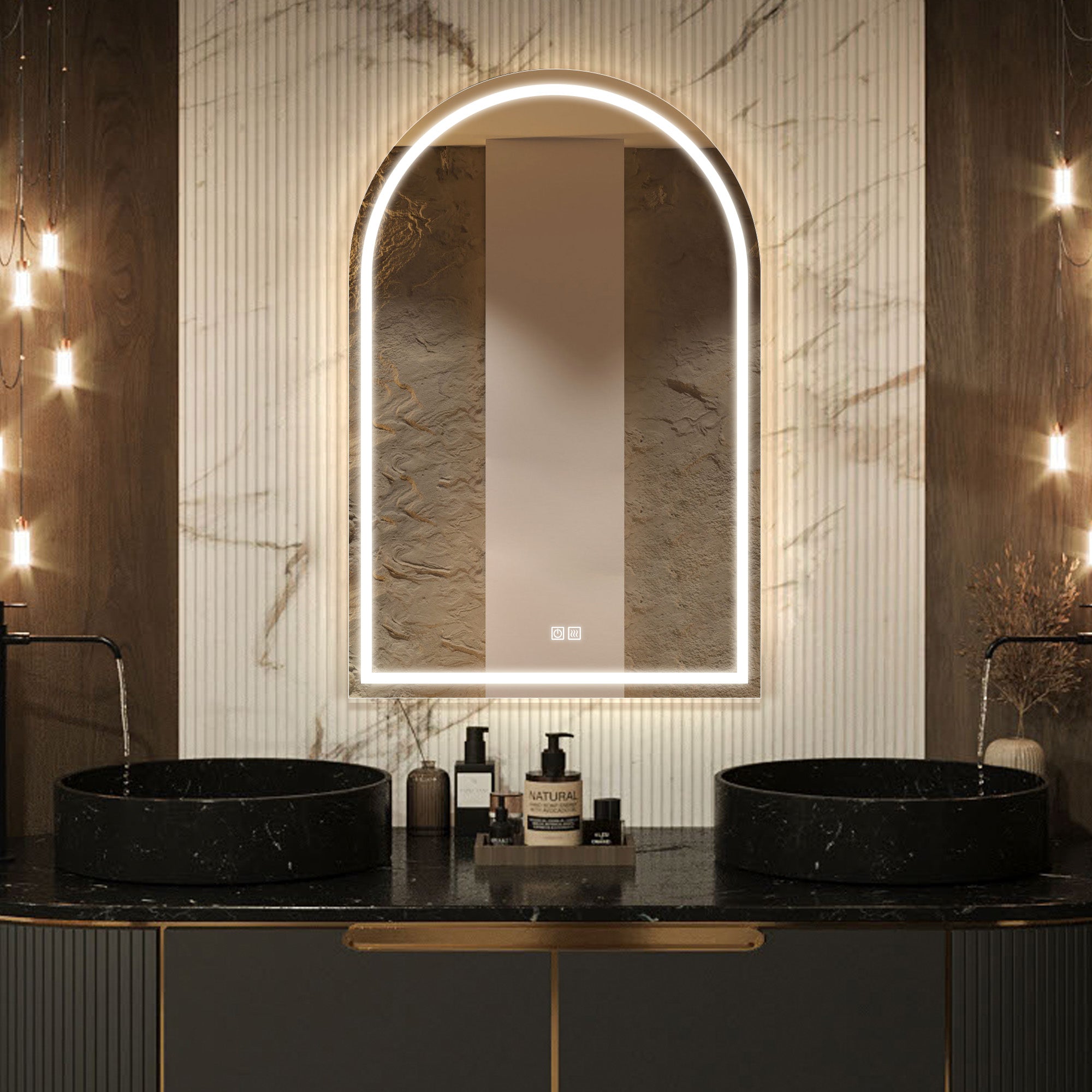
The IYRA arched mirror shows an illuminated-border design. Separate lights are also visible in this brand product image; it is not a test of mirror-only illumination or a verified customer installation.
Are LED mirrors bright enough? Ask for more than lumens
Some are suitable for mirror-side tasks; others are mainly decorative. The useful question is whether the selected model gives you sufficient, comfortable light where you stand—not whether its photograph looks bright.
NIST describes the lumen as the unit of total luminous flux. Lux measures illuminance: light received per unit area. A total-output number alone cannot show how that light is distributed across your face.
A real specification example
Robern publishes separate lumen and lux values for its Vitality mirrors. The following are manufacturer-reported values from the 3000K columns, not Inyouths measurements:
| Published model | Approximate light output | Approximate illuminance |
|---|---|---|
| YM0030CIFPD | 740 lumens | 530 lux |
| YM2440RCFPD | 1,110 lumens | 530 lux |
Sources: YM0030CIFPD specification, page 1 and YM2440RCFPD specification, page 1. Both give a measurement condition of 18 inches from the center of the mirror. Values are approximate; the sheets do not provide a full face-area map or all test details.
The two models list different lumen outputs but the same lux figure under their stated condition. This illustrates why you should ask for both the output and its measurement context. It does not establish that the mirrors perform identically throughout a bathroom.
The rectangular sheet is dated November 19, 2021; the round sheet’s publication date is not established. These are examples of documented specifications, not a claim about current stock or a buying recommendation. 530 lux is not presented here as a universal target.
Ask your supplier:
- Is the lumen figure for forward lighting, backlighting, or both?
- Is there an illuminance measurement at a stated distance and location?
- Which size, color setting and brightness setting was tested?
- Is there information about light distribution, not just a single point?
If measurements are unavailable, do not assume a large mirror will replace your existing light. Ask for a demonstration or retain flexibility in the lighting plan.
When should you keep other bathroom lights?
Keep or plan additional lighting when the mirror cannot serve the tasks and areas you need. A clear reflection at the basin does not tell you whether the shower or route through the room is adequately lit.
Before deciding, check:
- Your face: look for unwanted shadows and distracting glare at your normal position, including when you lean forward for grooming.
- Other users: assess each basin and the heights and positions of the people using it.
- The room after dark: daylight can conceal a weak evening lighting arrangement.
- Areas away from the mirror: review the shower, toilet, storage and walking route separately.
- Controls: confirm that you can use the lighting layers in the combinations you want.
A showroom or installed demonstration can help you judge comfort, but it is not a substitute for a documented lighting assessment. Ask an electrician or lighting designer to review the layout where necessary.
If the mirror and a light bar must share limited wall space, check the dimensions and installation instructions before ordering. Our bathroom mirror height guide explains the placement considerations; do not use a single center-height rule for every user and fixture.
Dimming does not necessarily change the light color
Brightness, color temperature and color rendering are separate specifications. A warmer-looking light is not automatically dimmer, and a cooler-looking light does not by itself establish better color rendering.
The U.S. Department of Energy’s explanation of color-tunable LEDs distinguishes white tuning from dim-to-warm behavior. Some systems deliberately become warmer as they dim; ordinary dimmability does not promise that feature.
Check whether your chosen model has a fixed color temperature, an option selected when ordering, switchable settings or adjustable white light. Also confirm the specified dimming method. Do not assume a mirror with a touch control works with an existing wall dimmer.
What to send before choosing a mirror-and-lighting setup
A useful configuration enquiry includes more than the mirror width:
- Vanity and available wall dimensions, plus the position of each basin.
- Existing light fixtures, ceiling lights and windows.
- Where people stand and whether the main task is makeup, shaving or general grooming.
- Preferred light color and desired brightness/color controls.
- A photograph or drawing showing existing power and fixture locations.
Have electrical changes reviewed against the selected product’s instructions and local requirements by a qualified electrician. This guide does not provide wiring instructions or approve a wet-area installation.
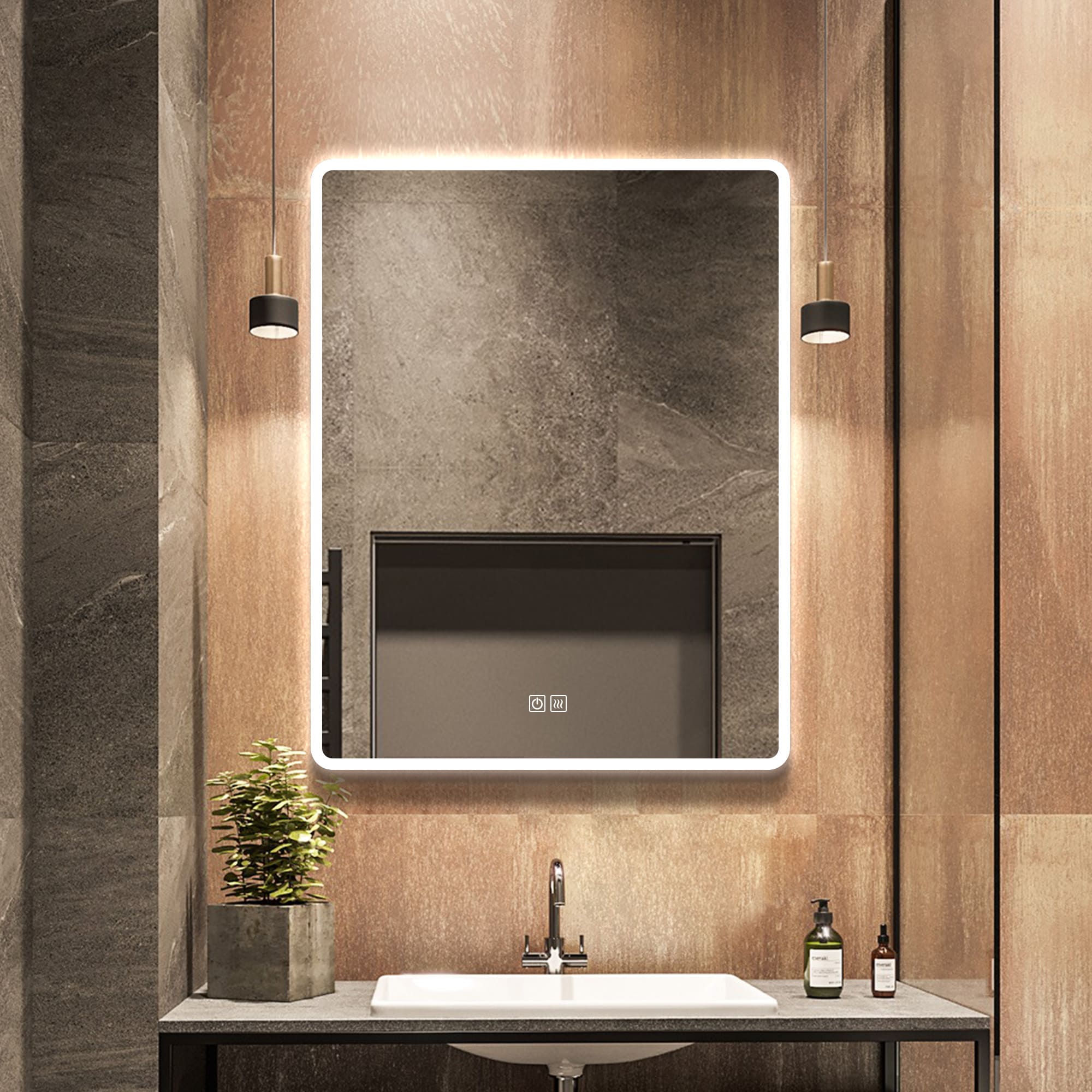
The HIMALIA mirror provides a rectangular design example. The surrounding pendants are part of the pictured setting; the image does not demonstrate how this mirror performs with those lights off. Check the product page for current dimensions, features, and customization options.
Frequently asked questions
Can a backlit mirror replace a vanity light?
Possibly, but the halo alone is not evidence. Confirm useful illumination toward the user at the intended position. If the mirror mainly lights the wall, keep or plan another source of grooming light.
Do I need both a light bar and a frontlit mirror?
Not necessarily. A separate bar may be unnecessary when the mirror provides suitable face lighting and the rest of the room has its own lighting. Check the selected model and layout rather than choosing by appearance alone.
Will a bigger LED mirror be brighter?
Size alone cannot answer that. Models differ in light direction, illuminated area, output and controls. Compare the specifications for the exact size and configuration you intend to order.
Can an LED mirror be the only light in a small bathroom?
Do not decide from room size alone. Check tasks and visibility throughout the room after dark. A mirror may work well at the basin while leaving other areas poorly served.
Should I remove my existing vanity light before ordering the mirror?
Confirm the mirror specifications and lighting plan first. Removing a fixture or changing its power supply before that decision can limit your options. Ask an electrician about retaining flexibility during the remodel.
Plan the lighting before removing the fixture
Browse Inyouths custom LED mirror designs, then send us your layout and existing light positions to discuss mirror configuration. Include the lighting you want to keep and the tasks you need to perform. A configuration discussion is not a substitute for a professional lighting or electrical assessment.

