
A good LED bathroom mirror should do more than brighten the vanity. It should make daily grooming easier, stay clear after hot showers, fit the wall properly, and match the style of the bathroom instead of looking like an afterthought.
This guide is written for homeowners and designers choosing a lighted bathroom mirror in 2026. It covers the main decisions first: size, lighting direction, shape, frame, anti-fog function, and optional smart features. Along the way, we will use a few Inyouths custom LED mirrors as examples, because custom sizing and feature selection are often the difference between a mirror that simply fits and one that feels built for the room.
Quick Answer: What Is the Best LED Bathroom Mirror?
For most bathrooms, the best LED bathroom mirror is a custom-size mirror with balanced lighting, dimmable color temperature, and anti-fog function. If the bathroom is used every day for shaving, makeup, or skincare, front lighting matters most. If the goal is a softer spa-like atmosphere, backlighting becomes more important. For a primary bathroom, a mirror with both front and back lights is usually the most flexible choice.
Inyouths makes custom LED bathroom mirrors in different shapes, sizes, lighting styles, frame finishes, and optional features. That means you can start with the bathroom wall and vanity size, then choose the mirror around the space instead of forcing a standard mirror to work.
What to Compare Before Buying
| Decision | Best choice if you want... | Watch out for |
|---|---|---|
| Mirror size | A mirror slightly narrower than the vanity, or a full-width custom mirror for a clean wall-to-wall look | Standard sizes that leave awkward gaps or interfere with outlets, faucets, or sconces |
| Frontlit vs backlit | Frontlit for face lighting; backlit for mood lighting; both for the most flexible setup | Using only backlight when you need strong makeup or shaving light |
| Shape | Rectangle for wide vanities, round for softer rooms, arched for height and elegance | Choosing shape only by trend without checking vanity width and ceiling clearance |
| Frame | Framed mirrors for a finished furniture-like look; frameless for clean minimal bathrooms | Mixing too many metal finishes in one small bathroom |
| Features | Anti-fog for steamy bathrooms, dimming for different routines, clock or Bluetooth only if useful | Adding features you will not use every day |
1. Start with Size: Custom Fit Matters More Than the Model Name
The most common mistake is choosing a mirror by product photo before measuring the wall. For a balanced vanity, the mirror is usually slightly narrower than the vanity, leaving a little breathing room on both sides. For a modern double vanity, one wide custom LED mirror can look cleaner than two separate mirrors, especially when the wall is tiled or the vanity has a long countertop.
Before ordering, measure the vanity width, backsplash height, faucet height, outlet position, ceiling clearance, and any wall lights. If your bathroom has an unusual wall width, an offset sink, or an extra-wide vanity, a custom-size LED mirror will usually look more intentional than a standard size.
2. Choose the Right Lighting: Frontlit, Backlit, or Both
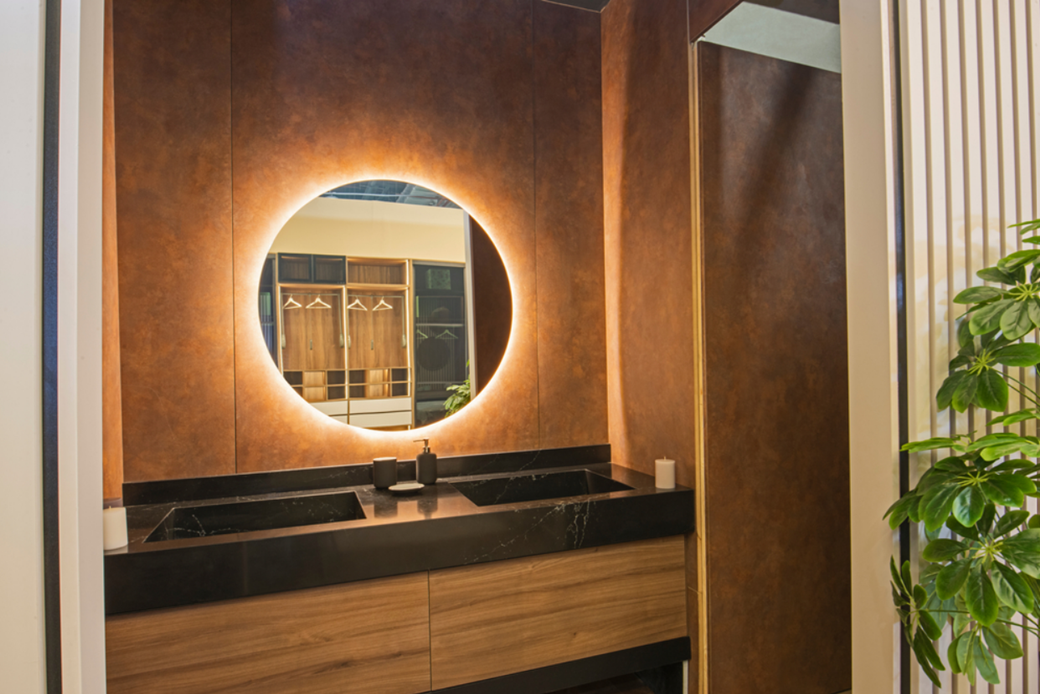
Front lighting is the better choice when the mirror is used for close-up tasks. It sends light toward your face, which helps with shaving, skincare, and makeup. Backlighting creates a softer halo behind the mirror and is better for ambience. It looks beautiful on tile, stone, microcement, and darker painted walls, but it should not be the only task light in a busy bathroom.
For a bathroom that needs both function and atmosphere, choose a mirror with front and back lights. The POLARIS custom LED bathroom mirror is a good example of this setup: the front light supports daily routines, while the backlight helps the wall feel more layered and finished.

3. Decide Whether You Need Anti-Fog
An anti-fog LED mirror is worth considering if the mirror is near a shower, the bathroom has limited ventilation, or several people use the room in the morning. A demister helps keep the central mirror area clearer after hot showers, so you do not have to wait for condensation to disappear before using the mirror.
Anti-fog is one of the custom options that tends to be useful long term. It does not change the look of the mirror much, but it changes how convenient the mirror feels every day.
4. Pick a Shape That Supports the Room
Rectangular LED mirrors are the safest choice for wide vanities and primary bathrooms. Round mirrors soften rooms with many straight lines. Arched mirrors make small or narrow bathrooms feel taller and more architectural. Irregular mirrors work best when the mirror is meant to be a design statement rather than a quiet background piece.
If your bathroom is compact, an arched mirror such as PROCYON can make the vanity area feel lighter without taking up visual space. If you want a softer rectangular mirror, rounded corners such as EIRENE can reduce the hard-edge feeling while keeping the mirror practical for daily use.

5. Choose a Frame or Frameless Look
A frameless mirror feels clean, light, and modern. A framed LED mirror feels more finished and can connect the mirror with faucets, cabinet handles, towel bars, and shower hardware. If your bathroom already has strong metal accents, a framed mirror can help the design feel deliberate.
The trick is restraint. In a small bathroom, too many finishes can feel busy. Match or complement one main finish, such as matte black, brushed gold, chrome, or nickel, rather than trying to repeat every metal in the room.

6. Use Smart Features Selectively
Smart features can be helpful, but they should support how you actually use the bathroom. Dimming and color-temperature control are useful for almost everyone because morning routines, evening baths, and guest use often need different light levels. A makeup mirror is useful for close-up grooming. Bluetooth, a clock, or a Wi-Fi weather station can be convenient, but they are best when you know they will be part of your routine.
In other words, do not customize for the longest feature list. Customize for the way the bathroom is used.
Best LED Bathroom Mirror Setups by Use Case
For a primary bathroom
Choose a custom rectangular mirror with both front and back lights, anti-fog, dimming, and adjustable color temperature. This gives the best mix of daily function and atmosphere.
For makeup and shaving
Prioritize front lighting and neutral color temperature. A frosted-edge frontlit mirror such as HIMALIA is a good direction if you want clearer face lighting without adding separate vanity sconces.

For a spa-like bathroom
Choose a backlit mirror with soft edges or rounded corners. Pair it with other bathroom lighting so the mirror creates atmosphere without becoming the only light source.
For a small bathroom
Choose an arched, round, or rounded-corner mirror. Keep the design simple, and avoid an oversized frame unless the vanity wall has enough room.
For a design-focused bathroom
Consider a framed mirror, edge-frosted detail, or an irregular shape. Use this approach when the mirror is meant to be one of the main visual features in the room.
LED Bathroom Mirror FAQ
Are LED bathroom mirrors worth it?
Yes, LED bathroom mirrors are worth it if you want better vanity lighting, a cleaner wall design, and practical features such as dimming, anti-fog, or color-temperature control.
Is frontlit or backlit better?
Frontlit is better for face lighting. Backlit is better for ambience. If the mirror is used every day and you also want a premium wall glow, choose both.
What color temperature is best for a bathroom mirror?
Neutral white is usually the most balanced for daily grooming. Warm white feels softer in the evening, while cool white feels crisp and bright. A mirror with adjustable color temperature gives you more flexibility.
What size LED mirror should I buy?
Start with the vanity width and wall constraints. The mirror should feel proportional to the vanity and should not crowd outlets, faucets, shelves, or lights. Custom sizing is helpful when standard dimensions leave awkward gaps.
Should I choose a custom LED mirror?
Choose custom if the bathroom has a non-standard vanity, a wide double sink, a narrow wall, special feature needs, or a specific design direction. Customization lets you select the size, lighting, shape, frame, and functional options around the room instead of adjusting the room around the mirror.
Final Recommendation
The best LED bathroom mirror is the one that fits your wall, supports your daily routine, and matches the room's design language. For most bathrooms, that means a custom-size mirror with dimmable lighting, anti-fog function, and a shape that works with the vanity. Start with size and lighting first, then decide whether frame, shape, and smart features are worth adding.
To compare available sizes, lighting styles, shapes, and options, browse the Inyouths custom LED bathroom mirror collection.